



 Pressure

Bourdon Tube
7 products
Boiler
2 productsChemical
3 products
Phenolic
1 product
Differential
7 products
Capsule
3 products
Test Pressure Gauge
5 products
Contact
4 products
Diaphragm
3 products
Diaphragm Seal
1 product
Digital
2 products
Pressure Transmitter
10 products
Pressure Switch
5 products
Load and Force
11 products
Accessories
15 products- Temperature
RTD
8 products
Bimetallic
2 products
Gas Filled
2 products
Non-Replaceable Inserts
3 products
Replaceable Inserts
4 products
Ceramic Protection
3 products
Mineral Insulated
3 products
Flameproof and Intrinsically Safe
4 products
Surface and Machinery
5 products
Food and Pharma
3 products
HVAC
6 products
Acids, Alkalis, Salts
4 products
Temperature Switch
1 product
Thermowell
4 products
Indicator, Controller
5 products
Accessories
6 products
Humidity
7 products
Thermocouple
23 products
Cable Sensors
8 productsHead Sensors
8 productsHigh Temperature
6 products
Temperature Transmitter
6 products - Flow

Electro Magnetic
2 products
Vortex
1 product
Swirl
1 product
Ultrasonic
7 products
Coriolis Mass Flowmeter
11 products
Positive Displacement
6 products
Variable Area
1 product
Differential Pressure
7 products
Turbine
4 products
Flap
1 product
Side Glass
1 product
Thermal gas
5 products
Air Flow/Quality
11 products
Flow Switch
9 products
Flow Computer
3 products
Flow Accessories
2 products
Dosing/Batching
6 products - Level
Radar
3 products
Ultrasonic
1 product
Capacitance
7 products
Conductivity
4 products
Magnetic
1 product
Float/Buoyancy
7 products
Level Indicator
3 products
Vibrating Rod
3 products
Rotary Paddle
2 products
Hydrostatic
2 products
Optical
1 product
Level Switches
11 products - Calibration Devices
Multi Function Calibrators
2 products
Pressure Calibrators
4 products
Temperature Calibrators
6 products
Valve Testing
1 product
Calibration Software
1 product  Valves
Actuator
1 product
Ball Valves
2 products
Butterfly Valves
3 products
Gate Valves
2 products
Globe Valves
3 products- Analytical Sensors
Water Quality Sensors
16 products
Process Systems
11 products
Density and Concentration
12 products
Analytical Controller
2 products - Process Systems






Compressed air quality classes, ISO 8573-1: limits for particles, water and oil, and how each is measured

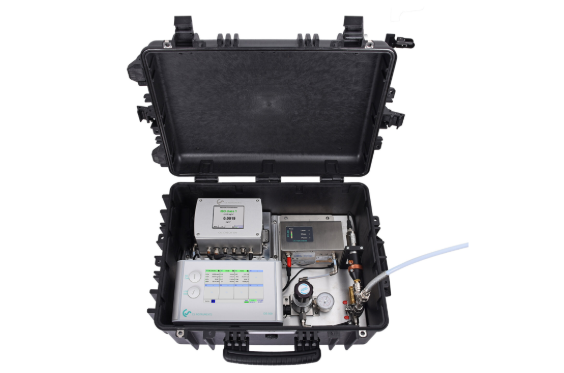
The compressed air quality classes of ISO 8573 grade air by three contaminants: solid particles, water and oil. Each gets its own class number, and a lower number means cleaner air. Schmierer SEA offers sensors for all three beside its compressed air flow meter range.
Compressed air quality classes (ISO 8573): the short answer
- A class is written as three numbers, always in the order particles, water, oil. For example, 3:4:2 means particle class 3, water class 4 and oil class 2.
- Class 1 allows 20,000 particles of 0.1 to 0.5 µm per m³, a pressure dew point of -70 °C and 0.01 mg/m³ of oil. It also limits the larger particles.
- In the compressed air quality classes of ISO 8573, class 0 is not zero contamination. Instead, the equipment user or supplier specifies it, and it must be stricter than class 1.
- The oil class covers liquid oil, aerosol and vapour together, so an oil vapour sensor alone cannot prove it.
- CS Instruments measures particles with the PC 400, dew point with the FA 510 and oil vapour with the Oil Check500.
Compressed air quality classes (ISO 8573-1): the tables
The current edition is ISO 8573-1:2010, which ISO last confirmed in 2017. A fourth edition is in preparation, so check the edition before you write it into a specification.
The limits below combine three public sources. First, particle limits come from the public preview pages of the standard. Second, water and oil limits come from the Compressed Air Purity Guide of the Compressed Air and Gas Institute (CAGI), which reproduces the ISO table with permission. Finally, we checked both against the class table in the CS Instruments Oil Check500 datasheet.
Particle classes
| Class | 0.1 to 0.5 µm (per m³) | 0.5 to 1 µm (per m³) | 1 to 5 µm (per m³) | Particle mass (mg/m³) |
|---|---|---|---|---|
| 0 | Stricter than class 1 | Stricter than class 1 | Stricter than class 1 | – |
| 1 | ≤ 20,000 | ≤ 400 | ≤ 10 | – |
| 2 | ≤ 400,000 | ≤ 6,000 | ≤ 100 | – |
| 3 | Not specified | ≤ 90,000 | ≤ 1,000 | – |
| 4 | Not specified | Not specified | ≤ 10,000 | – |
| 5 | Not specified | Not specified | ≤ 100,000 | – |
| 6 | – | – | – | Above 0 to 5 |
| 7 | – | – | – | Above 5 to 10 |
| X | – | – | – | Above 10 |
To earn a class, the air must meet the limit in every size range of that row. Counts refer to air at 20 °C and 100 kPa absolute, with no water vapour.
Water classes
| Class | Pressure dew point | Liquid water (g/m³) |
|---|---|---|
| 0 | Stricter than class 1 | – |
| 1 | ≤ -70 °C | – |
| 2 | ≤ -40 °C | – |
| 3 | ≤ -20 °C | – |
| 4 | ≤ +3 °C | – |
| 5 | ≤ +7 °C | – |
| 6 | ≤ +10 °C | – |
| 7 | – | Up to 0.5 |
| 8 | – | Up to 5 |
| 9 | – | Up to 10 |
| X | – | Above 10 |
Pressure dew point is the dew point at the specified pressure, not after the air expands. Classes 1 to 6 therefore describe vapour. From class 7 upwards, however, the limit is liquid water, so the air is already wet.
Oil classes
| Class | Total oil: liquid, aerosol and vapour (mg/m³) |
|---|---|
| 0 | Stricter than class 1 |
| 1 | 0.01 |
| 2 | 0.1 |
| 3 | 1 |
| 4 | 5 |
| X | Above 5 |
ISO defines oil here as hydrocarbons with six or more carbon atoms. The oil classes stop at 4, and anything above 5 mg/m³ is class X.
Where the sources differ
All three sources agree on the particle counts in the compressed air quality classes of ISO 8573. CAGI and CS Instruments also agree on every dew point and oil figure. Nevertheless, there are small differences:
- Oil limits: CAGI prints “less than” 0.01, 0.1, 1 and 5 mg/m³. By contrast, CS Instruments prints “less than or equal to”.
- Liquid water: CAGI gives 0.5, 5 and 10 g/m³ for classes 7 to 9. CS Instruments, however, leaves these classes empty and has no column for particle mass.
- Preview limits: The free preview pages stop after the particle table. For a contract or an audit, therefore, buy the standard itself.
How to read and specify a class
Read the numbers from left to right, and use a dash where a contaminant is not specified. So [-:4:-] sets only the water class. CAGI’s guide also shows how the compressed air quality classes of ISO 8573 are used in practice:
- Plant air: [-:4-5:-]. A refrigerated dryer normally reaches water class 4 or 5.
- Instrument air: CAGI reads the Instrument Society of America’s standard as [2:<4:3]. However, the dew point depends on the lowest ambient temperature.
- Process air: there is no single standard. In CAGI’s example, an air knife that touches a food product needs 2-2-1.
Before you choose from the compressed air quality classes of ISO 8573, ask the equipment maker what it requires. Then treat the main supply to the level most users need, and clean the rest further at the point of use. CAGI also warns that air can pick up contaminants in the network. As a result, a class measured in the compressor room may not hold at the machine.
Which sensor measures which contaminant
Once the target class is known, it becomes a sensor specification. The table sets the compressed air quality classes of ISO 8573 against the CS Instruments sensors on our product pages.
| Contaminant | ISO test method part | CS Instruments sensor | Stated figures | What it cannot show |
|---|---|---|---|---|
| Particles | ISO 8573-4 (count) | PC 400, laser particle counter | 0.1 or 0.3 µm version, three size bands, 28.3 l/min, up to 40 bar at the pressure reducer | Particle mass (classes 6, 7 and X); counts below 0.3 µm with the 0.3 µm version |
| Water | ISO 8573-3 (humidity) | FA 510, dew point sensor | -80 to 20 or -20 to 50 °C dew point; ±1 to ±3 °C; -1 to 50 bar; IP66 | The quantity of liquid water (classes 7 to 9 and X) |
| Oil | ISO 8573-2 (aerosol), ISO 8573-5 (vapour) | Oil Check500, photoionisation analyser | 0.001 to 5 mg/m³ oil vapour at 3 to 9 bar | Oil aerosol and liquid oil |
Particles: PC 400
The PC 400 particle counter counts in the same three size bands as the ISO table, provided you choose the 0.1 µm version. By contrast, the other version starts at 0.3 µm, so it misses part of the first band. That band is limited only in classes 1 and 2. For classes 3 to 5, consequently, the 0.3 µm version still covers every limited band.
Sampling time matters too. At 28.3 l/min, the counter needs about 35 minutes to see one cubic metre. Class 1 allows ten particles of 1 to 5 µm in that volume, or 0.28 particles per minute on average. In other words, one clean minute proves little at class 1.
Water: FA 510
The FA 510 dew point sensor comes in two ranges. Choose the -80 to 20 °C version, made for adsorption dryers, if you need water class 1 or 2. The -20 to 50 °C version suits refrigeration dryers and classes 4 to 6, while class 3 lies at its lower end.
Moreover, allow for the accuracy given in the FA 510 datasheet. Below -50 °C it is ±3 °C, so a reading must reach -73 °C to clear the class 1 limit by that margin. At class 2 the accuracy is ±2 °C, hence -42 °C. For class 4 it is ±1 °C, hence +2 °C. This margin is our own suggestion, though, not a rule of the standard.
Oil: Oil Check500 plus the laboratory
The Oil Check500 reads oil vapour continuously from 0.001 to 5 mg/m³, a range that spans the limits of oil classes 1 to 4. However, the class counts aerosol and liquid oil as well. CS Instruments says so itself: the analyser alone is not proof of the class. Instead, a laboratory measures aerosol and liquid oil to ISO 8573-2 and vapour to ISO 8573-5, by gas chromatography.
Laboratory sampling has limits of its own, though. In CS Instruments’ worked example, a tube sample must collect 50 µg. At 0.02 mg/m³ and 0.5 l/min, that takes 5,000 minutes, or about three and a half days. For class 1 the datasheet advises at least seven to nine days. The two methods therefore complement each other: the analyser shows when something changes, and the laboratory confirms the class.
CS Instruments states two detection limits. The technical data give 0.001 mg/m³, while the laboratory test in the same datasheet, made with benzene, found 0.0015 mg/m³ at 6 sigma. Both lie well below the class 1 limit.
Where and how to take the measurement
- Measure after treatment. The PC 400 is meant for filtered compressed air. Likewise, the Oil Check500 belongs after activated carbon or an oil-free compressor, always with a filter and dryer upstream. CS Instruments rules out fitting it straight after the compressor and tank.
- Check the gas first. The Oil Check500 needs 3 to 9 bar, 40 % relative humidity or less and a pressure dew point of +10 °C or lower. The PC 400 also accepts up to +10 °C, without condensation. Wet air of class 7 and above is therefore outside their limits.
- Watch the temperature. Oil results refer to 20 °C. A colder sample can show less vapour than the air at the consumer, so a heating element is available.
- Repeat it at the point of use. A second point near the critical machine then shows what the pipework adds.
- Record all three together. A suitably equipped DS 500 recorder does this, and the set is on our compressed air quality monitoring page. For flow, power and leaks as well, see how to plan a compressed air monitoring system.
Finally, set alarm limits from your own process. The compressed air quality classes of ISO 8573 give the limits, but not the warning point. CS Instruments notes that there is no standard value for oil. Instead, the threshold depends on the sampling point, the starting value and the warning time you want, among other things.
In short, the compressed air quality classes of ISO 8573 tell you what to allow. The sensors then show whether the air still meets it.
How Schmierer SEA can help
Tell us the class you must meet, the pressure and the dryer type. Our team in Shah Alam will then help you select the particle, dew point and oil vapour sensors, and a compressed air flow meter if you need one: send an enquiry.
Related reading
Disclaimer: This article is general engineering guidance from Schmierer SEA, not a specification or a safety recommendation for any particular installation. Confirm every figure against the instrument’s current datasheet and your plant’s procedures, and involve a qualified engineer for safety-related decisions. Information current as at November 2026.