



 Pressure

Bourdon Tube
7 products
Boiler
2 productsChemical
3 products
Phenolic
1 product
Differential
7 products
Capsule
3 products
Test Pressure Gauge
5 products
Contact
4 products
Diaphragm
3 products
Diaphragm Seal
1 product
Digital
2 products
Pressure Transmitter
10 products
Pressure Switch
5 products
Load and Force
11 products
Accessories
15 products- Temperature
RTD
8 products
Bimetallic
2 products
Gas Filled
2 products
Non-Replaceable Inserts
3 products
Replaceable Inserts
4 products
Ceramic Protection
3 products
Mineral Insulated
3 products
Flameproof and Intrinsically Safe
4 products
Surface and Machinery
5 products
Food and Pharma
3 products
HVAC
6 products
Acids, Alkalis, Salts
4 products
Temperature Switch
1 product
Thermowell
4 products
Indicator, Controller
5 products
Accessories
6 products
Humidity
7 products
Thermocouple
23 products
Cable Sensors
8 productsHead Sensors
8 productsHigh Temperature
6 products
Temperature Transmitter
6 products - Flow

Electro Magnetic
2 products
Vortex
3 products
Swirl
1 product
Ultrasonic
7 products
Coriolis Mass Flowmeter
12 products
Positive Displacement
6 products
Variable Area
1 product
Differential Pressure
7 products
Turbine
4 products
Flap
1 product
Side Glass
1 product
Thermal gas
5 products
Air Flow/Quality
11 products
Flow Switch
9 products
Flow Computer
3 products
Flow Accessories
2 products
Dosing/Batching
6 products - Level
Radar
3 products
Ultrasonic
1 product
Capacitance
7 products
Conductivity
4 products
Magnetic
1 product
Float/Buoyancy
7 products
Level Indicator
3 products
Vibrating Rod
3 products
Rotary Paddle
2 products
Hydrostatic
2 products
Optical
1 product
Level Switches
11 products - Calibration Devices
Multi Function Calibrators
2 products
Pressure Calibrators
4 products
Temperature Calibrators
6 products
Valve Testing
1 product
Calibration Software
1 product  Valves
Actuator
1 product
Ball Valves
2 products
Butterfly Valves
3 products
Gate Valves
2 products
Globe Valves
3 products- Analytical Sensors
Water Quality Sensors
16 products
Process Systems
11 products
Density and Concentration
12 products
Analytical Controller
2 products - Process Systems







Pressure gauge dial size: which size for which job

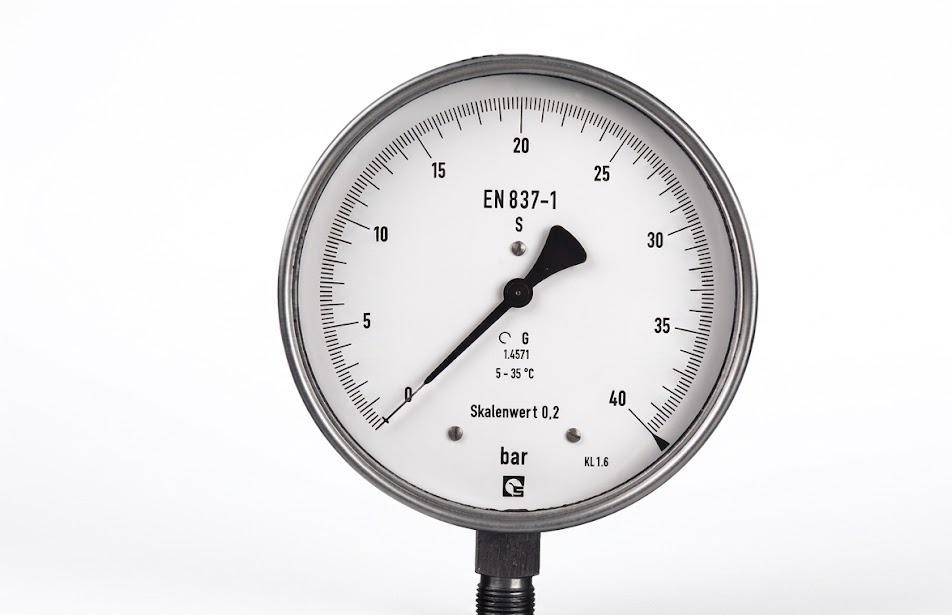
Pressure gauge dial size is the nominal diameter of the gauge, in millimetres or inches. It decides how far away you can read the pointer, how fine the scale can be and how much space the gauge needs. Our Bourdon tube pressure gauges run from 40 to 400 mm, so this guide matches each size to a job.
Pressure gauge dial size: the short answer
- 40 and 50 mm: small machines and tight spaces, read at arm’s length. EN 837-1 allows no class finer than 1.6 at these sizes.
- 63 mm: compact equipment and panels. On the SRU 25, this size has a 1/4 inch connection and 1.6% accuracy.
- 100 mm: process lines read from the floor or platform. The SRU 25 then has a 1/2 inch connection and 1% accuracy.
- 150 or 160 mm: gauges read from across a walkway, and test gauges of class 0.6 or 0.25.
- 250 mm and above: boiler fronts, high mounting points and test benches. The Schmierer R 400 is the largest gauge on this page.
What the pressure gauge dial size number means
The size on a datasheet is a nominal size, not a measurement of the printed dial. For example, Schmierer’s RU 50 drawing gives 54 mm across the front ring and 48.5 mm for dimension D1, and neither is 50 mm. Therefore always take the case and flange dimensions from the datasheet drawing.
The European standard for Bourdon tube gauges, EN 837-1, lists eight nominal sizes: 40, 50, 63, 80, 100, 150, 160 and 250. It then ties each one to the accuracy classes it may carry. As a result, the pressure gauge dial size you choose also sets the finest class you can ask for. The table combines the standard’s size, class and flange figures.
| Nominal size | Accuracy classes EN 837-1 allows | Flange diameter, maximum | Fixing hole circle |
|---|---|---|---|
| 40 and 50 | 1.6, 2.5, 4 | 61 mm (40), 71 mm (50) | 51 mm (40), 60 mm (50) |
| 63 | 1, 1.6, 2.5, 4 | 86 mm | 75 mm |
| 80 | 1, 1.6, 2.5, 4 | 110 mm | 95 mm |
| 100 | 0.6, 1, 1.6, 2.5 | 134 mm | 118 mm |
| 150 and 160 | 0.25, 0.6, 1, 1.6 | 186 mm (150), 196 mm (160) | 168 mm (150), 178 mm (160) |
| 250 | 0.1, 0.25, 0.6, 1, 1.6 | 290 mm | 276 mm |
In short, a class 0.25 gauge in a 100 mm case falls outside the standard’s table. If you need that accuracy under EN 837-1, start at 150 or 160 mm.
Pressure gauge dial size, connection and range in one table

The figures below come from our product pages and from the Schmierer and Schmierer SEA datasheets. Our own SRU 25 comes first, then its variants and the German Schmierer ranges.
| Gauge | Dial sizes | Connection | Range | Accuracy |
|---|---|---|---|---|
| SRU 25, all stainless steel | 63, 100 mm; 150 mm available | 1/4 inch BSP or NPT on 63 mm, 1/2 inch BSP or NPT on 100 mm | -1 to 100 bar as listed; special ranges up to 1,600 bar | 1.6% (63 mm), 1% (100 and 150 mm) of full scale |
| SRU 25X, with mini diaphragm seal | 100 mm; 150 mm available | 1/2 inch BSP gauge connection; seal connections from 1/4 to 3/4 inch on the datasheet | -1 to 400 bar with the mini seal | 1% of full scale |
| SRU 35, stainless steel case, copper alloy socket | 63, 100 mm; 150 mm available | 1/4 inch BSP or NPT on 63 mm, 1/2 inch BSP or NPT on 100 mm | -1 to 100 bar as listed; up to 600 bar on request | Confirm: the product page and the 2018 datasheet differ |
| SR 01, black steel utility | 40, 50, 63, 80, 100, 150, 250 mm | 1/8 to 1/2 inch, BSP or NPT | -1 to 100 bar as listed; higher ranges on request | 1.6% (63 mm and above), 2.5% (40 and 50 mm) |
| Schmierer RU, all stainless steel | 40, 50, 63, 100, 160, 250 mm | 1/8 inch BSP (40), 1/4 inch BSP (50, 63), 1/2 inch BSP (100 and above) | Per model | Class 1.6 (40, 50, 63 mm), 1.0 (100 mm and above); RU 50 above 600 bar is class 2.5 |
| Schmierer R, brass and bronze | 40, 50, 63, 100, 160, 250, 400 mm | 1/8 inch BSP (40), 1/4 inch BSP (50, 63), 1/2 inch BSP (100 and above) | Per model | Class 1.6 or 2.5 (40, 50, 63 mm), 1.0 (100 mm and above) |
| PCU05, phenolic case | 115 mm | 1/2 inch BSP or NPT | -1 to 1,600 bar | 0.5% (ANSI B40.1) |
| SRU15 and SR15 boiler gauges | 250 mm | 1/2 inch BSP, bottom entry; confirm for the configuration | Confirm on the datasheet | Confirm on the datasheet |
| Schmierer F and FU test gauges | 160, 250 mm | 1/2 inch BSP | Per model | Class 0.6; 0.25 on request |
Connection size follows dial size for a reason. A larger case is heavier, so it puts more load on the stem. Schmierer gives about 0.1 kg for the RU 50, 1.2 kg for the RU 160 and 2.4 kg for the RU 250. Accordingly, the RU moves from a 1/4 inch thread at 63 mm to 1/2 inch at 100 mm. The SRU 25 stainless steel pressure gauge makes the same step.
Reading distance: how far away is the operator?
Reading distance is the first question to ask about pressure gauge dial size. A dial looks smaller in proportion to distance, so the comparison is simple geometry. For instance, a 250 mm dial at 4 m looks the same size as a 63 mm dial at 1 m. The table is a worked example on that basis, not a rating from a datasheet.
| Dial | Looks the same size as a 63 mm dial at 1 m | 270° arc at the nominal diameter | Arc per bar on a 0 to 10 bar scale |
|---|---|---|---|
| 63 mm | 1.0 m | 148 mm | 14.8 mm |
| 100 mm | 1.6 m | 236 mm | 23.6 mm |
| 160 mm | 2.5 m | 377 mm | 37.7 mm |
| 250 mm | 4.0 m | 589 mm | 58.9 mm |
| 400 mm | 6.3 m | 942 mm | 94.2 mm |
A bigger dial also has a longer scale. The pointer on a Schmierer RU sweeps 270°, so a larger dial spreads the same range over a longer arc. In practice the printed scale sits inside the case edge, so the true arc is shorter. However, the ratio between sizes is still a fair guide: the arc on a 100 mm dial is about 1.6 times as long as on a 63 mm one.
Before you size up, check three other things. First, good lighting and a dial turned towards the reader can save a size. Second, a smaller range makes each bar easier to see, if the working pressure still suits it. Finally, if nobody can stand where the gauge is readable, choose a gauge with an output signal instead of a bigger dial.
Mounting: stem, panel or wall
Mounting often sets the upper limit on pressure gauge dial size. The SRU 25 datasheet, for instance, lists bottom entry, lower back entry, a wall mount, and lower back entry with a front flange or a bracket. Similarly, the RU 160 datasheet offers a front flange for panels, a back flange for walls and an eccentric back connection.
- Directly on the pipe: 63 and 100 mm suit most lines. If the line vibrates, a large, heavy case on a thin stem is a poor choice, so move the gauge to a wall or bracket.
- In a panel: allow for the flange, not the dial. Under EN 837-1 a 100 mm gauge may have a flange up to 134 mm across, so space the cut-outs to suit.
- On a wall or post: 160 and 250 mm gauges belong here, because the wall then carries the weight and a small-bore line brings the pressure.
Some options also need a certain size. Schmierer builds electrical contacts into cases from 100 mm, and its electronic contacts come only in 100 and 160 mm. Likewise, Schmierer’s datasheets for the R and RU list the Manodamp damped movement on the 100, 160 and 250 mm sizes, but not on the RU 40 and 50, the R 40 to 63 or the R 400. Meanwhile, the SRU 25 datasheet lists no blow-off disc for the 63 mm size.
Boiler gauges: old dial size rules in Malaysia

If a Malaysian specification asks for a six inch boiler gauge, the figure matches regulation 14 of the 1970 steam boiler regulations. Regulation 54 then set three inches for unfired pressure vessels, or two inches where the shell was under twelve inches in diameter and the pressure not more than 150 psi. Both also asked for a scale from one and one-third to two times the authorised safe working pressure, with that pressure marked in red.
However, DOSH now lists the 1970 regulations among the rules that have been abolished. The 2024 certificate of fitness regulations, in operation since 1 June 2024, name a pressure gauge as an essential fitting on steam boilers and pressure vessels. They also require fittings to follow a recognised standard, but we found no dial size in the text. So confirm the pressure gauge dial size against your design code and with your inspecting body.
If your specification still says six inches, note the arithmetic. Six inches is 152.4 mm, so a nominal 150 mm gauge, although sold as 6 inch, is slightly under it and a nominal 160 mm gauge is only 7.6 mm over. Confirm the printed dial diameter as well. Our SRU15 and SR15 boiler gauges have 250 mm dials.
How to choose a pressure gauge dial size
- Measure the reading distance. Stand where the operator stands, then use the comparison table above.
- Set the accuracy class. For general process gauges, class 1 and 1.6 are open from 63 mm upwards. However, class 0.25 means 150 mm or more.
- Check the space and the support. Look at the flange, the weight and the vibration.
- Match the connection. If the tapping is 1/4 inch, a 63 mm gauge fits without an adaptor; otherwise, ask for a special thread.
- List the options. Contacts, Manodamp and blow-off discs may rule out the small sizes.
- Standardise. Finally, keep to two or three sizes on site, because spares are then easier to hold.
On many process lines these steps end at a 100 mm SRU 25. If you want stainless steel in 40, 50, 160 or 250 mm, look at the Schmierer RU pressure gauge instead.
Frequently asked questions
What are the standard sizes of pressure gauges?
EN 837-1 lists 40, 50, 63, 80, 100, 150, 160 and 250 as nominal sizes. However, makers also build other sizes: the PCU05 has a 115 mm dial, and the Schmierer R series reaches 400 mm.
What is the dial on a pressure gauge?
The dial is the round plate with the printed scale, behind the pointer. On Schmierer’s RU gauges, for example, it is white with black lettering. The SRU 25 dial shows both bar and psi.
What is the standard thread size for pressure gauges?
EN 837-1 gives parallel threads G 1/8, G 1/4, G 3/8 (not preferred) and G 1/2, and tapered 1/8, 1/4 and 1/2 NPT. On the Schmierer RU and R, 1/4 inch BSP goes with 50 and 63 mm, and 1/2 inch BSP with 100 mm and above.
How Schmierer SEA can help
Send us the medium, range, reading distance and connection, and we will suggest a pressure gauge dial size and model from our pressure gauge range. Common gauges are kept in warehouse stock, and we calibrate them in-house or on site. To start, send an enquiry, or compare the Bourdon tube gauge models.
Related reading
- Types of pressure gauge: how each one works and where it fits
- Pressure gauge with stabiliser movement
Disclaimer: This article is general engineering guidance from Schmierer SEA, not a specification or a safety recommendation for any particular installation. Confirm every figure against the instrument’s current datasheet and your plant’s procedures, and involve a qualified engineer for safety-related decisions. Information current as at November 2026.