



 Pressure

Bourdon Tube
7 products
Boiler
2 productsChemical
3 products
Phenolic
1 product
Differential
7 products
Capsule
3 products
Test Pressure Gauge
5 products
Contact
4 products
Diaphragm
3 products
Diaphragm Seal
1 product
Digital
2 products
Pressure Transmitter
10 products
Pressure Switch
5 products
Load and Force
11 products
Accessories
15 products- Temperature
RTD
8 products
Bimetallic
2 products
Gas Filled
2 products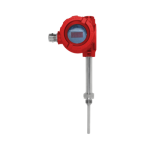
Non-Replaceable Inserts
3 products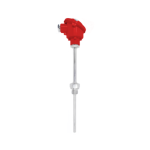
Replaceable Inserts
4 products
Ceramic Protection
3 products
Mineral Insulated
3 products
Flameproof and Intrinsically Safe
4 products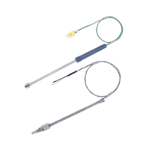
Surface and Machinery
5 products
Food and Pharma
3 products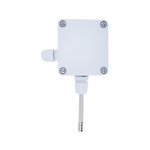
HVAC
6 products
Acids, Alkalis, Salts
4 products
Temperature Switch
1 product
Thermowell
4 products
Indicator, Controller
5 products
Accessories
6 products
Humidity
7 products
Thermocouple
23 products
Cable Sensors
8 productsHead Sensors
8 productsHigh Temperature
6 products
Temperature Transmitter
6 products - Flow

Electro Magnetic
2 products
Vortex
3 products
Swirl
1 product
Ultrasonic
7 products
Coriolis Mass Flowmeter
12 products
Positive Displacement
6 products
Variable Area
1 product
Differential Pressure
7 products
Turbine
4 products
Flap
1 product
Side Glass
1 product
Thermal gas
5 products
Air Flow/Quality
11 products
Flow Switch
9 products
Flow Computer
3 products
Flow Accessories
2 products
Dosing/Batching
7 products - Level
Radar
3 products
Ultrasonic
1 product
Capacitance
7 products
Conductivity
4 products
Magnetic
1 product
Float/Buoyancy
7 products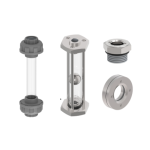
Level Indicator
3 products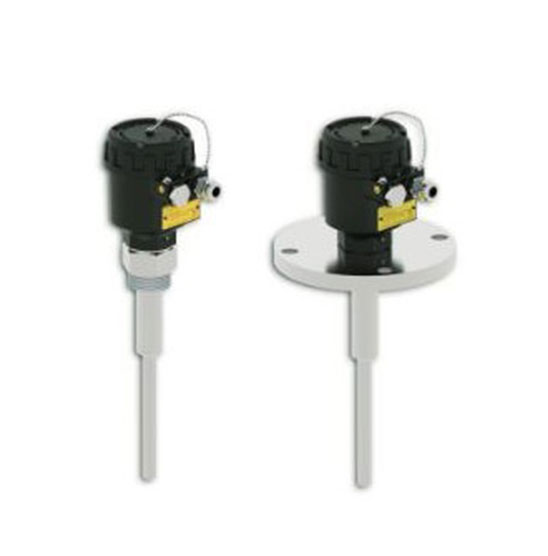
Vibrating Rod
3 products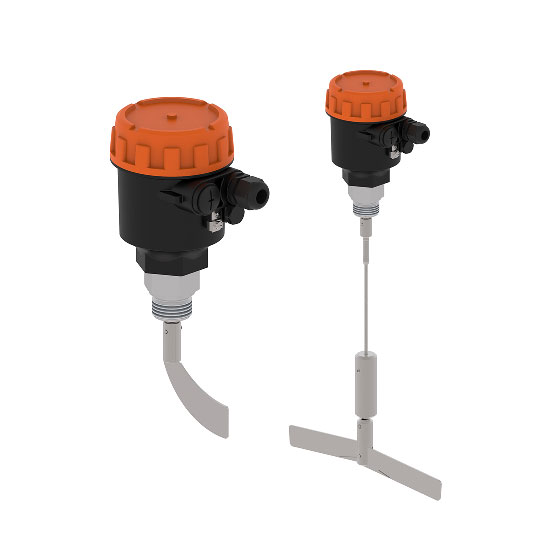
Rotary Paddle
2 products
Hydrostatic
2 products
Optical
1 product
Level Switches
11 products - Calibration Devices
Multi Function Calibrators
2 products
Pressure Calibrators
4 products
Temperature Calibrators
6 products
Valve Testing
1 product
Calibration Software
1 product  Valves
Actuator
1 product
Ball Valves
2 products
Butterfly Valves
3 products
Gate Valves
2 products
Globe Valves
3 products- Analytical Sensors
Water Quality Sensors
16 products
Process Systems
11 products
Density and Concentration
12 products
Analytical Controller
2 products - Process Systems






How does a bimetallic thermometer work, and when should you choose one?

How does a bimetallic thermometer work? It senses heat with two bonded metals that expand by different amounts, so the pair bends. Wound into a coil inside the stem, the pair twists as the temperature changes, and that twist turns the pointer on the dial. It needs no battery or power supply.
You can see the instrument itself under bimetallic thermometers. This guide, meanwhile, explains the mechanism, and then shows what it means for stem length, range and thermowell.
How does a bimetallic thermometer work: the short answer
- Two metals with different expansion rates are bonded together along their length.
- Heat lengthens one more than the other, so the bonded pair bends. Cooling, in turn, reverses the movement.
- A coil in the stem turns that bend into rotation, and a shaft carries the rotation to the pointer.
- The coil senses over a length, not at a point. Therefore each range has a minimum stem length.
- Our STU02 comes in ranges from -100 to 60 °C up to 0 to 500 °C, in class 1 of EN 13190.
Why two bonded metals bend
Every metal grows by its own amount when heated. HyperPhysics, the physics reference at Georgia State University, gives a typical pair: brass and steel, at 19 and 13 parts per million per degree Celsius. Bonded together, neither can slide past the other. So the pair has to curve, with the metal that grew more on the outside.
For example, take 100 mm of each and heat both by 100 °C. Brass grows by 0.19 mm and steel by 0.13 mm, a difference of only 0.06 mm. That example uses the HyperPhysics pair; the datasheet for our STU02 does not name its two metals.
From a tiny bend to a pointer you can read
A short, straight strip moves too little to drive a dial. However, a longer strip bends further, and a coil packs a long strip into a narrow stem. HyperPhysics also notes that makers coil the strips to increase their sensitivity.

So how does a bimetallic thermometer work from the process to the dial? The chain runs in four steps:
- Heat reaches the coil. The process warms the stem, and the stem then warms the coil inside.
- The coil twists. Because one end is fixed, the movement appears at the free end.
- The shaft turns. A shaft along the stem takes the rotation up to the case.
- The pointer moves. Finally, the dial shows the temperature in degrees.
Nothing in that chain needs electricity. On the other hand, nothing in it produces a signal, so someone has to walk up and read it.
How does a bimetallic thermometer work within its range? The STU02 figures
The figures below come from our STU02 datasheet (revision 06/18, archived copy). They are a selection, because the sheet lists 19 ranges.
| Dial range (°C) | Measuring range (°C) | Limit of error (±°C) | Minimum stem, 6 and 6.35 mm diameter (mm) | Minimum stem, 8 to 10 mm diameter (mm) | Minimum stem, 12 mm diameter (mm) |
|---|---|---|---|---|---|
| -40 to 60 | -30 to 50 | 1 | 110 | 100 | 100 |
| -20 to 60 | -10 to 50 | 1 | 120 | 100 | 100 |
| -20 to 120 | -10 to 110 | 2 | 90 | 80 | 80 |
| 0 to 60 | 10 to 50 | 1 | 140 | 120 | 120 |
| 0 to 100 | 10 to 90 | 1 | 90 | 75 | 100 |
| 0 to 120 | 10 to 110 | 2 | 75 | 65 | 80 |
| 0 to 160 | 20 to 140 | 2 | 70 | 60 | 80 |
| 0 to 200 | 20 to 180 | 2 | 65 | 55 | 70 |
| 0 to 250 | 30 to 220 | 2.5 | 70 | 70 | 70 |
| 0 to 300 | 30 to 270 | 5 | 90 | 80 | 80 |
| 0 to 400 | 50 to 350 | 5 | 80 | 70 | 70 |
| 0 to 500 | 50 to 450 | 5 | 80 | 70 | 70 |
What the table means for your choice
Two columns deserve a closer look. First, the measuring range is narrower than the dial. Two triangular marks on the dial show it, and the limit of error applies only between them. For example, a 0 to 100 °C dial has a limit of ±1 °C from 10 to 90 °C. On a 0 to 120 °C dial, however, the limit is ±2 °C, so a wider range than you need can cost accuracy.
Second, the minimum stem length is also the minimum immersion length. A 6 mm stem needs 140 mm on the 0 to 60 °C range, but only 65 mm on 0 to 200 °C. The maximum lengths are 500 mm for 6 and 6.35 mm stems, 900 mm for 8 to 10 mm, and 1000 mm for 12 mm. In a small pipe, therefore, check the immersion before anything else.
Stem, entry and case options on the STU02
- Entry: bottom, centre back, every angle, or bottom with an elbow. Every angle lets you turn the dial towards the reader.
- Connection: adjustable, fixed or swivel. A connection that slides on the stem, for instance, lets you set the insertion on site.
- Material: AISI 316 stem and connection, with an AISI 304 case; a 316 case is an option.
- Case: IP65, for ambient temperatures from -25 to 65 °C. In addition, a dampening liquid is an option.
- Zero: the pointer is zero adjustable, and external zero adjustment is an option.
Connection sizes are on the STU02 bimetallic thermometer page.
How does a bimetallic thermometer work with a thermowell?
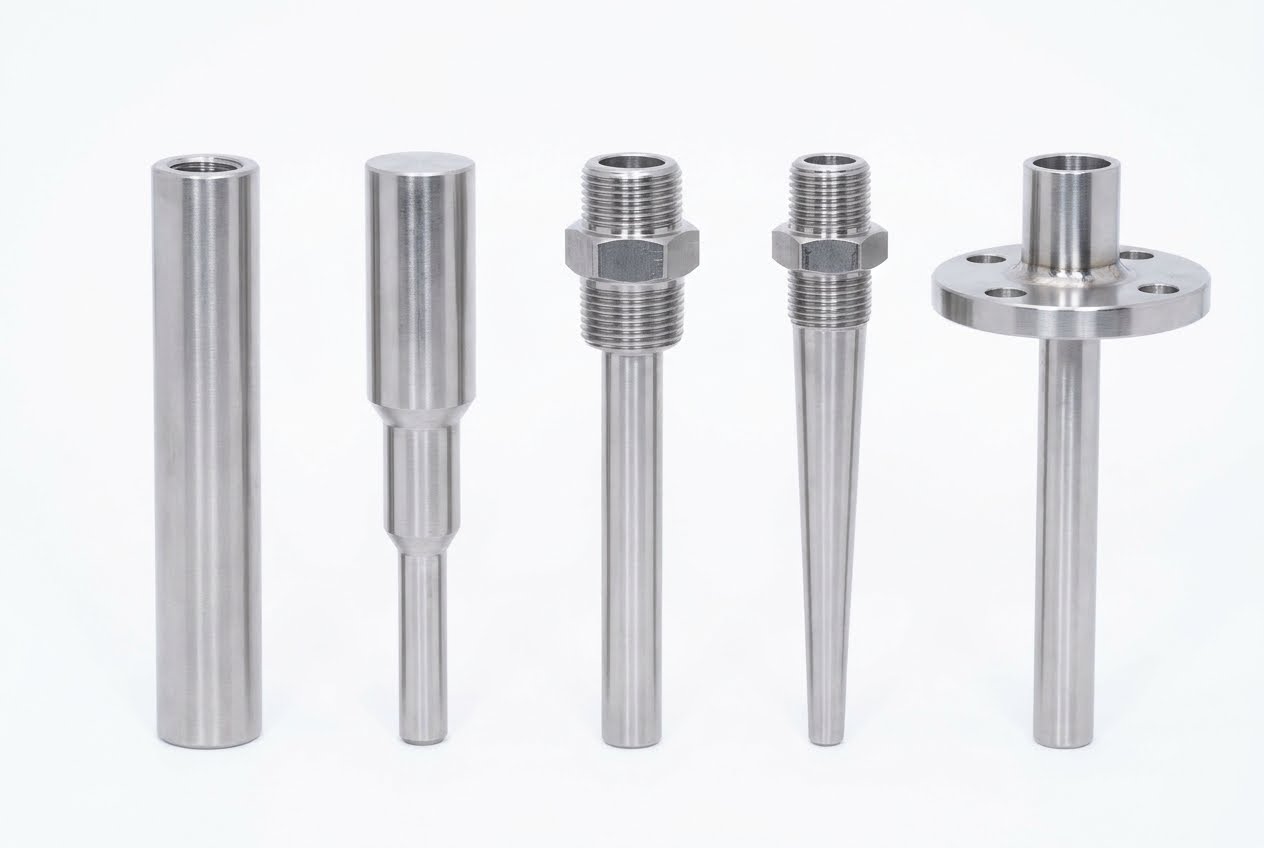
The datasheet limits the STU02 without a thermowell to 25 bar. Above that, in aggressive media, or wherever you cannot drain the line, the stem goes into a thermowell. The well holds the pressure, so the thermometer can come out while the line stays in service.
However, a well puts metal and an air gap between the process and the coil, so the reading follows changes more slowly. Four checks help:
- Bore: match it to the stem diameter with little clearance.
- Depth: let the tip reach close to the bottom of the bore without jamming against it.
- Immersion: put the minimum length from the table in the medium, not in the branch or the insulation.
- Thread: match the instrument connection to the thread in the well.
Also, never force the dial round by hand to face you. Instead, slacken the connection or the angle joint first, because a strained stem can shift the reading.
When to choose a bimetallic thermometer
How does a bimetallic thermometer work best? As a local reading on pipes, tanks and equipment where there is no power and nobody needs a signal. For a dial mounted away from the point, however, a gas filled thermometer with capillary is the usual answer. For a control loop or a record, use a resistance thermometer or thermocouple instead.
Frequently asked questions
What is the proper placement of a bimetallic thermometer?
Place it where the medium flows past the stem, with at least the minimum immersion length in the medium. Dead legs, by contrast, can read late or wrong. Next, turn the dial to where people stand. Finally, keep the case within its ambient limit, which is 65 °C on the STU02.
How does a bimetallic strip look?
It looks like one thin metal strip, because the two layers are bonded over their whole length. Inside a dial thermometer, however, it is a coil hidden in the stem.
How does a bimetallic thermostat work?
It uses the same bending strip, often coiled. The movement, however, opens or closes an electrical contact at a set temperature instead of turning a pointer.
How Schmierer SEA can help
Perhaps your question is no longer “how does a bimetallic thermometer work” but which bimetallic thermometer to order. Tell us the process temperature, pressure, pipe size, connection and reading position through the enquiry form, or call +60 3 3344 8819. We also calibrate temperature instruments in-house and on site.
Related reading
- How to choose a protection tube for a temperature sensor
- Types of pressure gauge: how each one works and where it fits
Disclaimer: This article is general engineering guidance from Schmierer SEA, not a specification or a safety recommendation for any particular installation. Confirm every figure against the instrument’s current datasheet and your plant’s procedures, and involve a qualified engineer for safety-related decisions. Information current as at November 2026.