Description
Product Types
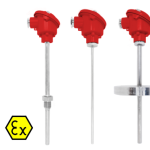
The Limatherm intrinsically safe Exia HVAC sensor platform maps into three tailored mounting styles. Thus, you can match your exact ventilation duct, cleanroom wall, or outdoor facility layout:
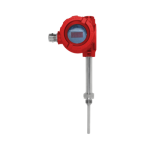
- Exia Duct-Mount HVAC Series: Outfitted with an elongated stainless steel immersion probe and adjustable mounting flange. Therefore, technicians insert the sensing tip directly into hazardous ventilation and exhaust air ducts.
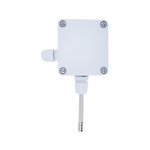
- Exia Room & Wall-Mount Series: Engineered with a compact, surface-mounted enclosure featuring an external or ventilated sensing tip. Consequently, it monitors ambient air temperatures inside battery rooms, paint booths, and solvent storage facilities cleanly.
- Exia Outdoor & Weatherproof Series: Built with a shielded IP65 housing and sun/rain guard. Thus, it delivers accurate ambient temperature feedback in exposed refinery yards and chemical tank farms.
Working Principle
The sensor operates continuously within an intrinsically safe (Ex ia) circuit connected to an approved Zener barrier or galvanic isolator in the safe area. First, moving duct air or ambient room air flows across the stainless steel sensing sheath. Next, the internal platinum Pt100 or Pt1000 resistance element captures subtle temperature shifts between -40°C and +85°C immediately. Thus, it generates a precise, linear electrical resistance change. Because the intrinsic safety barrier restricts voltage, current, and stored energy below ignition thresholds—even under fault conditions—no spark or excessive surface heating can occur. Finally, the terminal block or ATEX-certified head transmitter routes this clean signal back to your BMS or PLC.
Key Specs
| Technical Parameter |
Manufacturer Specification |
| Explosion Protection |
ATEX / IECEx Certified Intrinsically Safe (II 1/2G Ex ia IIC T6 / II 1/2D Ex ia IIIC) |
| Sensing Element |
Single or Double Platinum RTD: Pt100 or Pt1000 per EN 60751 (Class A or Class B) |
| Operating Temperature Range |
HVAC Climate Spectrum: -40°C up to +85°C continuous operation |
| Probe & Enclosure Materials |
AISI 316L / 321 Stainless Steel probe tube with rugged IP65 aluminum or polymer terminal box |
| Process & Duct Mounting |
Adjustable sliding mounting flange for air ducts or integrated wall-mount bracket |
| Signal Output Options |
Direct 2, 3, or 4-wire RTD resistance or ATEX-certified 4–20 mA / HART loop transmitter |
Product Models & Functional Configurations
The Limatherm intrinsically safe Exia HVAC sensor catalog offers tailored mechanical builds. Moreover, it includes verified hazardous-area electronics options:
- Custom Duct Immersion Lengths: Manufactured with tailored stainless steel probe lengths (such as 100 mm, 200 mm, or 300 mm). Therefore, the sensing tip reaches the center airflow stream inside insulated HVAC ducts cleanly.
- Direct Ex i RTD Wiring vs. AP-Ex Transmitters: Equipped with a ceramic terminal block for direct 2, 3, or 4-wire barrier wiring, or an ATEX-certified AP-Ex / LTT-Ex transmitter. As a result, it converts resistance into a noise-immune 4–20 mA signal.
- 2-Wire, 3-Wire, or 4-Wire RTD Circuits: Supplied in 2-wire, 3-wire, or 4-wire layouts. Consequently, engineers eliminate lead-wire resistance errors over long runs to the building management system (BMS).
- Certified Ex Cable Glands & IP65 Seals: Outfitted with ATEX-approved M20x1.5 cable entries and weather-tight gaskets. Thus, housings block dust, humidity, and corrosive fumes effectively.
Advantages
- Certified Zone 0, Zone 1 & Zone 20 Safety: Strict Ex ia energy limitation and T6 temperature classification prevent ignition sparks completely. As a result, your facility monitors HVAC air streams safely inside explosive gas and dust zones.
- Fast Airflow Thermal Response: Slim stainless steel probe tubes respond rapidly to moving air temperature changes. Therefore, ventilation dampers, heaters, and chillers maintain tight climate stability.
- High Platinum RTD Accuracy: Conforming to EN 60751 Class A/B tolerances, internal Pt100 and Pt1000 elements deliver drift-free readings over years of continuous service.
- Easy Installation & BMS Integration: Adjustable sliding duct flanges, wall brackets, and optional 4–20 mA transmitters simplify wiring into industrial PLCs and building automation panels.
Applications
HVAC, safety, and facility engineers integrate Limatherm Exia HVAC temperature sensors across hazardous ventilation and climate zones:
- Spray Paint Booths & Solvent Extraction Ducts: Monitors supply and exhaust air temperatures safely inside volatile organic compound (VOC) ventilation mains.
- Battery Charging Rooms & Hydrogen Storage: Tracks ambient room climate continuously where explosive hydrogen gas accumulation risks exist.
- Pharmaceutical Cleanrooms & Chemical Warehouses: Supervises air handling units (AHUs) and storage rooms handling flammable solvents and powders.
- Grain Silos, Flour Mills & Dust Collection Systems: Delivers spark-safe duct and ambient temperature feedback inside combustible dust Zone 20 and Zone 21 facilities.




 Pressure


















 Valves